
Read Yalobusha Property Tax Records
No single office holds everything. Yalobusha County property tax records draw on several custodians. The Tax Assessor keeps ownership maps, classification, the tax roll, and homestead support. Billing and collection records sit with the Tax Collector. Delinquency and sale records sit there too. Mississippi Department of Revenue rules govern assessment classes, ratios, due dates, and appeals.
| Field | What It Shows | Where |
|---|---|---|
| Owner and parcel | January 1 roll identity and tax-map key | Tax Assessor |
| Assessed components | Cultivated, uncultivated, improvement, and total assessed amounts where populated | Assessor and MARIS |
| Classification and exemptions | Ratio class and approved relief affecting taxable amount | Tax Assessor under DOR rules |
| Bill and payment | Tax year, amount, receipt, paid or delinquent status | Tax Collector |
| Sale or forfeiture | County sale trail, redemption, or later state inventory status | Collector, Chancery, and SOS |
Assessed value comes from state ratios. It is not a likely sale price. The tax bill applies millage and any relief to the taxable base. A deed may show sale consideration, and that figure belongs in its own column. Keep these numbers separate.
Split Yalobusha Tax Office Roles
The Yalobusha County Tax Assessor finds, classifies, inspects, and values property. The Tax Collector takes real and personal payments. The office also handles manufactured homes and car tags. It runs the annual delinquent real-property sale. For deeds, liens, plats, and land evidence, the Chancery Clerk is the source. This matters when an ownership or legal-description question touches the tax record. State DOR guidance explains the legal framework but never issues the local bill. Take a value question to the assessor. Take a balance, receipt, or delinquency question to the collector. Bring the parcel number, owner name, property description, and tax year. Yalobusha has two judicial districts, so call ahead for the right office.
Note: A payment confirmation proves a payment only, not clear title or an exemption decision.
Check Yalobusha's January 1 Owner
Mississippi assesses property to the owner of record on January 1. A deed recorded later can be newer than the name on the tax roll. Yalobusha County publishes no set closing-to-roll update interval, so assume no fixed lag. When ownership changed near the start of a year, compare the roll against the most recent Chancery deed record. The assessed owner is also not always the mailing recipient or occupant. Rural land can carry an out-of-state tax mailing address. The legal description and full parcel identifier are stronger matching points than a mailing city alone.
Look Up a Yalobusha Tax Bill
The Yalobusha property payment portal offers payment categories for real property, personal property, mobile homes, solid waste, and car tags. Its landing page exposes no public bill search and no prior-year history. The posted service fee is 3.75 percent for real, personal, and mobile-home payments. The car-tag notice states 3.75 percent or $3.75. Verify the live charge before paying.
- Find and copy the complete parcel ID from the Assessor or MARIS layer.
- Ask the Collector for the named tax year, original bill, balance, payment status, and receipt.
- Check classification, assessed value, and exemptions with the Assessor.
- If delinquent, ask about sale date, redemption, maturity, and any Chancery instruments.
- Assessed value
- The value produced after applying the statutory class ratio to true value.
- Millage
- The levy applied to the taxable assessment.
- Homestead exemption
- Property-tax relief for a qualifying owner-occupied home after approval.
- Tax lien
- A claim arising from unpaid tax, distinct from a deed or ownership finding.
The portal choices and service-fee notice are visible in the official source capture below.
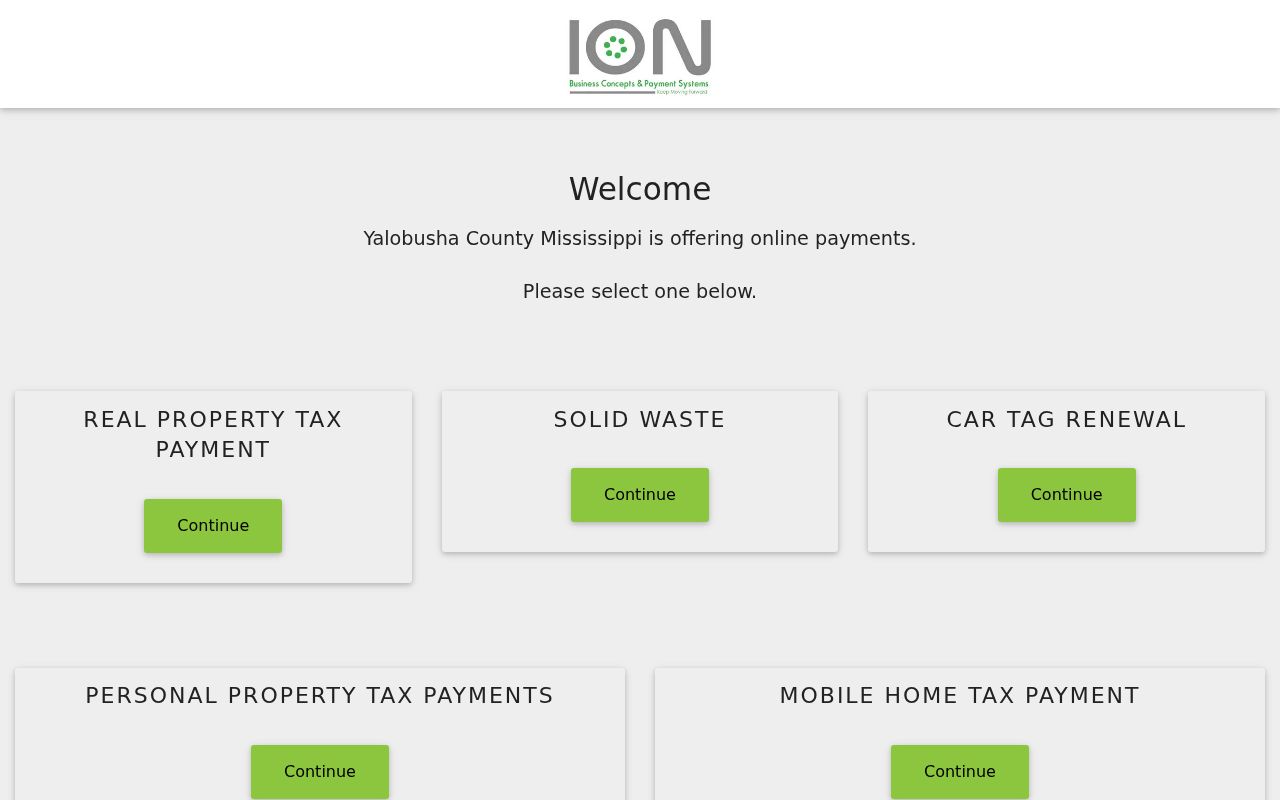
The image shows which payment categories the Collector accepts. For full bill history or a delinquency record, contact the Collector directly.
Apply for Yalobusha Homestead Relief
Mississippi DOR homestead guidance sets the filing window from January 1 through April 1. The local Tax Assessor helps with applications. Evidence depends on the relief claimed. Age or disability categories carry their own support requirements. A former owner's exemption does not move with the deed. Ask the assessor what proof the current year requires. Ask whether a change in ownership, marital status, occupancy, or use calls for a new filing. Approved relief changes the taxable result, never legal ownership or market sale price.
Understand Yalobusha Assessment Classes
Mississippi applies five assessment classes. DOR puts Class I owner-occupied residential real property at a 10 percent ratio. Classes II and III use 15 percent. Classes IV and V use 30 percent. The assessor assigns classification under state rules. True value, class ratio, exemptions, and millage each play their own part in the calculation. Real property is revalued at least every four years, yet the tax roll is annual. A county-wide valuation shift does not prove the same shift for every parcel. So check the individual land, improvement, class, and exemption facts before comparing years.
Review Yalobusha's 2025 Roll
Local reporting in March 2025 covered a state-mandated update. Taxable property value would rise more than 20 percent. A later report said the assessor presented a 2025 assessed roll of $90,164,503. It spans mobile homes, utilities, land, personal property, and auto tags. Those figures are county-wide snapshots, not proof of one parcel's market value or increase. Use the assessor's individual record and the DOR appeal framework for decisions. The news explains why a year-to-year comparison may deserve closer review.
Note: Compare like fields and the same classification. A change in assessed value is not always a change in market price.
Trace Yalobusha Delinquent Taxes
Delinquent taxes in Yalobusha County move through two separate stages. The Tax Collector runs the annual sale of real property with unpaid taxes. Later, if the land goes tax-forfeited, it can enter the Secretary of State's system. The SOS tax-forfeited search lets you filter by county, address, subdivision, parcel, PPIN, owner, value, legal description, and section-township-range. A Yalobusha County parcel number narrows the list fast.
The statewide inventory map went live in May 2025. It extends the paper trail. But a listing alone settles nothing about redemption, maturity, title, or whether the land is still available. Before you act, check the Collector's sale record, the Chancery Clerk's instruments, and the SOS land representative. The official search page also displays the statewide filters. You would use those for a narrow Yalobusha County query.
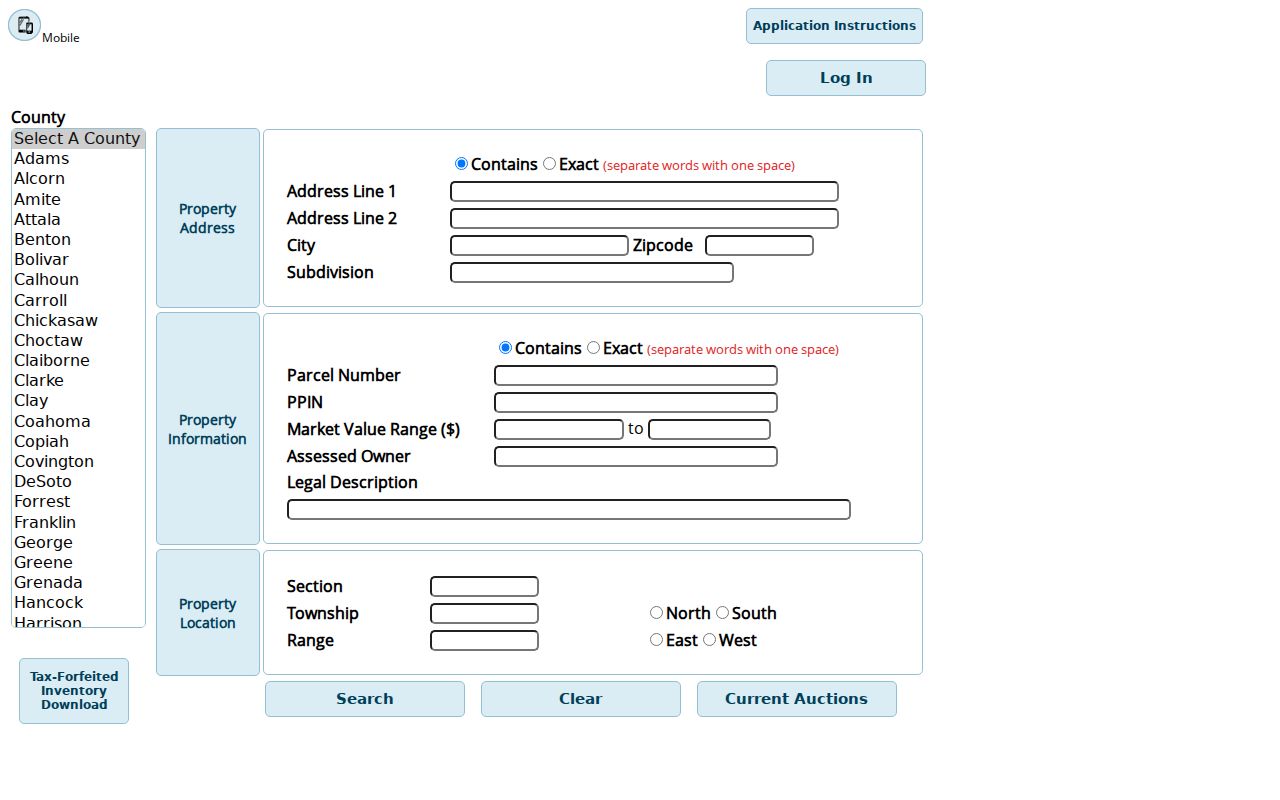
The official form itself shows the options. Parcel, owner, legal description, and PLSS each offer a distinct way to narrow the Yalobusha County inventory.
Contest a Yalobusha Assessment
An assessment dispute in Yalobusha County starts at the Tax Assessor's office. Identify the parcel, the tax year, and the specific problem. The fault may be a value component or a classification. It could also be a factual error. Strong evidence helps. Bring the parcel card, photographs, a recent survey, the deed and legal description, condition facts, comparable sales, or proof of an exemption. The Board of Supervisors holds its local hearing by the first Monday in August. That hearing comes before taxes come due.
There is also a state route. DOR materials describe a Review Board appeal filed within 20 days of the assessment action. Filing runs through TAP, email, mail, or hand delivery. The deadline depends on the current assessment process. Confirm the exact notice date and filing instructions first.
Act on the notice. Contact the Yalobusha County Tax Assessor at once. Verify the local Board calendar and any 20-day state-review period before a deadline passes.
A good appeal targets the assessed record, not the bill alone. Pull the parcel card and look hard at the numbers. Check land and improvement values, acreage, classification, ownership date, homestead status, and the physical facts the assessor has on file. Always compare the same value type for the same tax year. A nearby sale only helps when the parcel and its conditions are truly comparable, and the assessor can walk you through how the state ratios were applied.
Some disputes are not about judgment at all. If ownership or acreage is the issue, gather the deed, legal description, plat, and any survey that supports the correction. The assessor keeps the roll. The Chancery Clerk holds the recorded land evidence. File copies by whatever method the current notice states, and keep proof of delivery.
Request Offline Yalobusha Tax Records
Not every Yalobusha County property tax record sits behind a public search form. The Assessor can supply the parcel card, ownership map, valuation components, classification, exemption status, and the roll entry it maintains. The Collector handles bills, receipts, payment status, delinquency history, and tax-sale records. Name the year you need. A current balance will not answer a prior-year question.
You can ask at the counter, by phone, mail, fax, email where accepted, or in a written request under the Mississippi Public Records Act. Give the parcel ID, owner, situs or mailing address, legal description, date range, desired format, and a request for a fee estimate. Older tax-forfeiture and land records live at MDAH. The SOS inventory covers the later state-held stage.
When two sources disagree, write down their dates and custodians. The annual roll, the payment ledger, a deed, and the statewide map can each reflect a different event. A dated county record plus direct office confirmation beats an undated third-party summary every time.